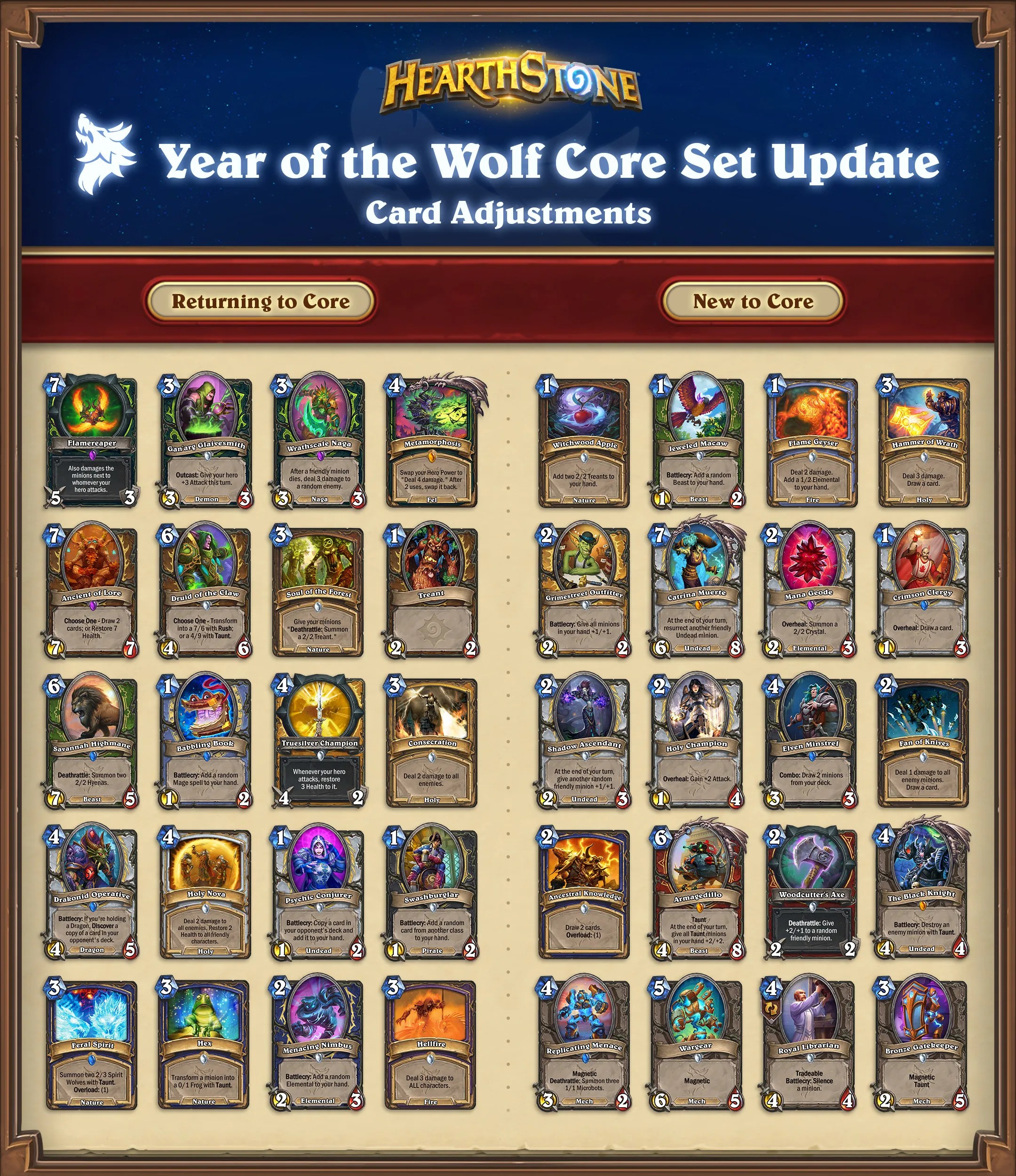
Hearthstonerecently revealed the Core set for the Year of the Wolf - the eighth year of Standard for Blizzard’s long-running digital TTRPG. The new Core set rotation takes place in April alongside the Festival of Legends set, after which the cards from Forged in the Barrens, United in Stormwind, and Fractured in Alterac Valley will leave Standard and enter Wild. Like previous Core sets, allHearthstoneplayers will have free access to these cards until the next Core set.
Game Rant spoke with senior game designers Cora Georgiou and Aleco Pors -Hearthstone’sinitial and final design leads respectively - about the Year of the Wolf. The developers discussed ways this year’s Core set is going to be different throughHearthstone’sfocus on adaptability and change. By sharing lessons it learned from past sets, and the challenges overcome while designing the new Core set, Georgiou and Pors painted an optimistic picture forthe Year of the Wolf inHearthstone.The following interview has been edited for clarity and brevity.

RELATED:Hearthstone Devs Share Lessons Learned while Making the Year of the Wolf Core Set
Q: In what ways has the design philosophy for the Year of the Wolf Core set changed since last year?

Pors:That’s a good question. I’d say we did a few new things this year that I don’t think we’ve done in previous years. I could point to a number of examples, but in general, the overarching philosophy here is that we wanted to add more flexibility to our approach to the Core set. For example, we addedTradeable as a new Core mechanicto the game. Of course, Tradeable was in the last year of the game. That means we’re keeping cards, moving them straight from Standard to the Core set.
There are a few examples of us doing that in individual classes. For example, Dark Bishop Benedictus has really elevated the shadowidentity of Priest, and has done so in a way that has been healthy for the class and has allowed us to design around that in really interesting and cool ways. So, we are keeping that card as well and moving that into Core for the next rotation. I’d say that’s one example of how we’re trying to be a little more flexible with the Core set in this coming year.
Q: Can you talk about the process that led to you keeping Tradeable as an evergreen keyword inHearthstone?
Georgiou:That was an easy decision to make. We really like Tradeable from a design standpoint because it allows us to make tech cards that maybe wouldn’t normally be super competitive. And players really enjoy Tradeable, so it just seemed to make sense to continue designing with it in mind. Obviously, with any keyword, making it evergreen is a big decision to make. We don’t want to commit to doing something forever unless we’re really sure. But we were pretty sure about this one.

Q: As you were shaping this year’s Core set and meta, what lessons did you learn from the Year of the Gryphon and the Year of the Hydra Core sets that informed your decisions?
Georgiou:There were a lot of lessons we learned from the last two years. In particular, it’s a lot of fun when the Core set is powerful. These are cards we’re intentionally giving to all players for free so they have this wonderful baseline to build decks from and feel like they have a leg up overprevious years when the Core set wasn’t in existenceyet. But, because the Core set is something that is going to be around for the whole year, if you have power pieces, like Brann Bronzebeard for instance, it can be a little difficult to design powerful Battlecries knowing Brann is going to be a factor for the entire year.

RELATED:Hearthstone Reveals New Program to Support Content Creators
It is not easy trying to find that balance of wanting the Core set to feel powerful while giving these constant options for players to build these exciting decks from, and for us to be able to design off of knowing we have these core pieces to support various archetypes over the course of the year. But, you do undertake some risks when you’re putting some of these powerful pieces in the Core set. We must be able to identify when there might be risks we are taking, take risks even though they are risky, and be flexible like Aleco said. Being able to pivot when we need to, being able to adapt our design philosophy for future sets to be able to fit, and being able to balance when we have to. There are a lot of moving pieces to commit to having this pool of cards for an entire year.
Pors:To Cora’s point, when we want to take risks with the Core set—which is obviously something we want to do, right?—you have to take risks to create a really fun game. We’re excited to use the Core set not just for this initial rotation, but over the course of the coming year as a balance lever more than we have in the past. We are a little more open to the idea of potentially bringing in new things, and even in extreme cases, moving something out or making numbers adjustments to things in the Core set in order to enable us to take more of those risks.

Georgiou:An example of that would be when we weremaking Murder at Castle Nathrialast year. We really would have loved it if we had some Secrets in the Rogue Core set, so we didn’t have to make three new Secrets that felt similar to old Secrets just because they were the only ones in Standard at the time. Obviously, when we were building out the Core set for the year, we didn’t know we were going to be doing Secret Rogue at the time, so it wasn’t something we had factored in, but maybe if we were going to do that this year, we would just put a couple of Rogue Secrets into Core in the middle of the year. Maybe that’s something that will just make the game experience better for our players, so I think we should be open to it.
Q: Did you have to make tough decisions about any other controversialHearthstonecards like Brann Bronzebeard in the upcoming Core set?
Georgiou:Look, I’ve tried to put Carnivorous Cube in the Core set for the last three years. It has not worked out. But every time we go into the initial design for the first set of the year, we like to occasionally dupe a card, put it into the set, and see what would happen if we were playing with old cards as though they were going to be in the Core set. Every time, without fail, we’re like “What if we tried Carnivorous Cube with this new archetype we’re doing for the Core set that we haven’t even thought about yet?” And, without fail, when it goes to final design, it gets cut. But maybe next year. Maybe the year after.
Pors:It is Chakki! But no, there are others as well.
Georgiou:Look, he’s not wrong. But it is maddening.
RELATED:Hearthstone: Legendary Mage Card Revealed for Festival of Legends [EXCLUSIVE]
Pors:Core has two major aspects that it’s doing – more than two, but two that I’ll highly here at least. It needs to be used toreinforce class identitiesin a lot of ways. There are a number of cards in Core that are excellent signposts for what we want the classes to be doing and are pieces that are very easy for us to build future sets for the next year around. And then, there’s also neutral, which overlaps with all the classes. That’s not so much about enforcing identities as much as it is about giving people flexible, exciting, and cool things to do.
We’re definitely aware of some of the discussions of cards in Core that a number of players view as potentially frustrating. Shadowstep would be a leading candidate among these cards being discussed, but when we think about what it means to bea Rogue with Shadowstep, and how Rogue gets to act, we view that as a really strong part of the Rogue’s core identity. So that’s a card we’re keeping around. We think it’s a card that is fun to build around - but again, we’re thinking about flexibility going into the future, so who knows?
Q: In some Core sets,Hearthstoneadds some new cards. Are there any in the Year of the Wolf Core set, or is it all previously-existing cards this time?
Pors:I don’t think there’s anything with a completely new name, completely new textbox or anything, but we definitely used the Priest’s Core set to reinforce this new Overheal mechanic we’re doing. There are going to be a number of cards that previously did not have the Overheal mechanic, but are now going to have the Overheal mechanic on them. A good example of this is Mana Geode. That card cared about being healed. Now, we just put Overheal on the card to really hook into this new thing. I’d say there are a number of cards, particularly there, that are redesigns, but I don’t think there is anything that is a completely new design.
Q: The last set of the Year of the Hydra introduced the new Death Knight class toHearthstone. How was it designing the first Core set for this new class?
Georgiou:Well in this case, it was really easy becauseDeath Knight hasn’t been out for all that long, and we had crafted their Core set when the class was released in March of the Lich King. We essentially said, “they haven’t had that long to play with it, so we don’t feel the need to make significant changes at this time.” I don’t think any of the Death Knight cards in Core have changed going into this year. It is possible we will add to it over the course of the year, but for now, we felt they are a lot of fun to play. They are pretty competitive – players are finding a bunch of different ways to build decks with the Death Knight class, which is exactly what we wanted. We would like to just encourage that, we’re pretty happy with it.
RELATED:Hearthstone: The New Death Knight Class Explained
Pors:It takes a while to build up a diverse library of cards that have come out set after set to really create a high degree of maneuverability from Core set to Core set.Hearthstoneis a nine-year-old game, and we’ve been able to do that really well with a lot of our core classes. Buteven Demon Hunter, our previous newest class, still feels like we’re building up that library. There were some unique challenges in trying to come up with the Demon Hunter Core set to still make it feel fresh. We weren’t going back to things we’d been leaning on before, and we were aligning it with the modern design standards ofHearthstone. And Demon Hunter is relatively old compared to Death Knight, of course!
Q: Cards released during the Year of the Gryphon are leaving Standard and going into the Wild format. What lessons did you learn from the major cards from those sets, such as the Questlines or Hero cards?
Georgiou:The Year of the Gryphon had some really wonderful highs, but also had some definite lessons we learned. Hero cards were really exciting for us to do for a second time. We tried a bunch of different ways to make them markedly different from when they wereoriginally done in Knights of the Frozen Throne, tried ways to link them, but eventually, we decided “Well, if it ain’t broke, it’s probably exciting still.”
We made these individual designs that we think held up pretty well. Certainly, there were some balance changes over the two years but they were wonderful representations of these characters, and it was avery character-forward yearso that was one of the big goals we were going in with. As far as Hero cards go, I was very happy with those. We would potentially do them again somewhere down the line, though we like to take a little bit of a break from doing a wide mechanic like that across all the classes. But definitely something we would pursue again in the future.
Questlines are… contentious, I think is a kind way I will put them. There are some pros in that they are very good at telling players how to build a deck. They say “This is your win condition, this is the end point of your game, build a deck that helps to drive you to this point.” For newer and returning players, being able to be that signpost during the deck-building process is not a bad thing.
But, there is certainly a lot of risks when you’re putting that much power and endgame potential into a card you are always going to have. The nature of Quests and Questlines always being in your hand on turn one, being something very difficult for players to play around or to counter can make decks feel very samey, and can make games feel like they’re ending in the same way. That’s a big lesson for us to have learned.
RELATED:Why the Recent Hearthstone Esports News Has Fans Nervous
Quests the first two times around were really good at driving players to build a certain type of deck, but not necessarily ending the game at such a conclusive point. There were still different directions a game could have gone when you finished Ossirian Tearas a Druidfrom Uldum. Questlines are something we would have to think long and hard before doing again. We would need to, as a design team, come up with some significant ways to find improvement there. I don’t think that should be something players should be worried about any time soon. There were some good lessons there, I think a lot of players had fun with them, but it’s their time to go, and I think that’s okay. They were wonderful at telling a story, which is something we were really trying to do that year. But, like any year, you live and learn, and you get better going forward.
Q: The Year of the Gryphon had some of the first cards that were banned in Wild, but not in Standard. What is the plan for these cards as they are cycling out of Standard?
Georgiou:I know there is a list of cards that are going to be either unnerfed or unbanned in Wild going into this new year. Obviously, it was the right decision at the time to preserve the integrity of the Wild format, but making it so there are cards that can’t be played in Standard orWildHearthstoneis not what we would like to see happen. I don’t have the list in front of me, but I would expect more information about that pretty soon.
Pors:I can’t recall every card – Chakki did the bulk of the work on that. What I can say about the Warlock Questline, The Demon Seed, we were aware of the degree to which that card was very strong in Wild before it was banned. We took a relatively conservative approach to the numbers we’ll be giving it when it comes back in Wild. We don’t want it to reappear as this Tier 1 menace everyone has to beat right away. Our goal with it is that it’s something you can try if you really want to, but we hope it isn’t going to be this hyper meta-dominant force, and if it is for whatever reason, we would make adjustments to it to stop that from being true.
Georgiou:I will say there is one very spicy unnerf I’m really excited to see people react to. I’m 99.9% sure we ended up doing it, so I really hope we did. So be on the lookout for that.
Q: If you had to pick a favorite card from the Year of the Gryphon that is not coming to Standard, what would you pick?
Pors:I got one. Potentially controversial, but I love the Guff Hero card. I really did. When I was interviewing for the team, I was asked what my favorite card was, and that was my answer then, so I’ll stick with that. Druid was my first class I got to 1000 wins, so as a Druid fan, it just does something I so badly want to do in Druid. It gives me the mana – that’s why I’m there – it even increases the maximum.
It does this thing that feels like it’s breaking the rules in a way. I realize that’s a source of frustration for non-Druid fans, of course, but it so perfectly captured exactly what I wanted to be doing in Druid that I’m definitely going to be missing that card in my late-game-oriented Druid decks.
RELATED:Hearthstone: How to Play Classic Combo Druid
Georgiou:That’s a long year! I’m running through a list now, and there are a couple that stand out. I’m really interested in bringing back theglory of Control Warrior, so Shield Shatter is one I’m going to miss. It’s just a phenomenal card, and I really think they could use it, but that’s okay, we can make a new AoE for Warrior.
I also really liked Vanndar. I think Vanndar decks are super greedy, they were never super competitive, but they were always really fun to make. There was a really cool dream there. And probablyRaid Boss Onyxia, even though she wasn’t super played by the end of her tenure. I liked how she was this really big, imposing figure. It felt like her design fit her story really well.
Q: The Year of the Wolf is the 8th year of Standard. How do you pick the animal each year, and what are you going to do for the 13th year after you fill up the zodiac signs?
Georgiou:Fortunately, we’re not there yet! I know that for a long time, we leaned intomythical animals in World of Warcraft. I think that was really fun. The wolf is a bit of a deviation from that. We had a couple of frontrunner choices, but we like to, if we can, fit the zodiac animal to a loose representation of what the year’s going to be if we can find those hooks. It’s not always perfect, but the wolf felt like it fit for this year pretty well. And, it looks darn good in the astrological symbol, so I’m pretty happy with it.
Pors:When we were brainstorming potential names for thisHearthstoneyear, I threw out Year of the Platypus. There’s a possibility it could come back. Are they even a real creature? They feel mythical.
Georgiou:Those are darn mythical. The only mammal that lays eggs? That’s cool. I’ve never seen one, so they must be. But we’re fortunate to have this wealth of characters and animals in World of Warcraft to pull from, so I don’t think we’ll be running out any time soon.
Q: Any final thoughts on the Year of the Wolf Core set?
Pors:I’m super excited for players to see this and get their hands on it. It’s a lot of work to put a Core set together. It took a lot of people a lot of time to do all this. You have to adjust the numbers, find what you have to keep, what should be leaving and everything. This is a big project that I’m really excited for players to see, and to start getting their feedback on it to keep getting better and better at making new Core sets in the years to come.
[END]
Hearthstoneis available now for Mobile and PC.
MORE:Hearthstone Focusing on Adaptability and Versatility in the Year of the Wolf
